
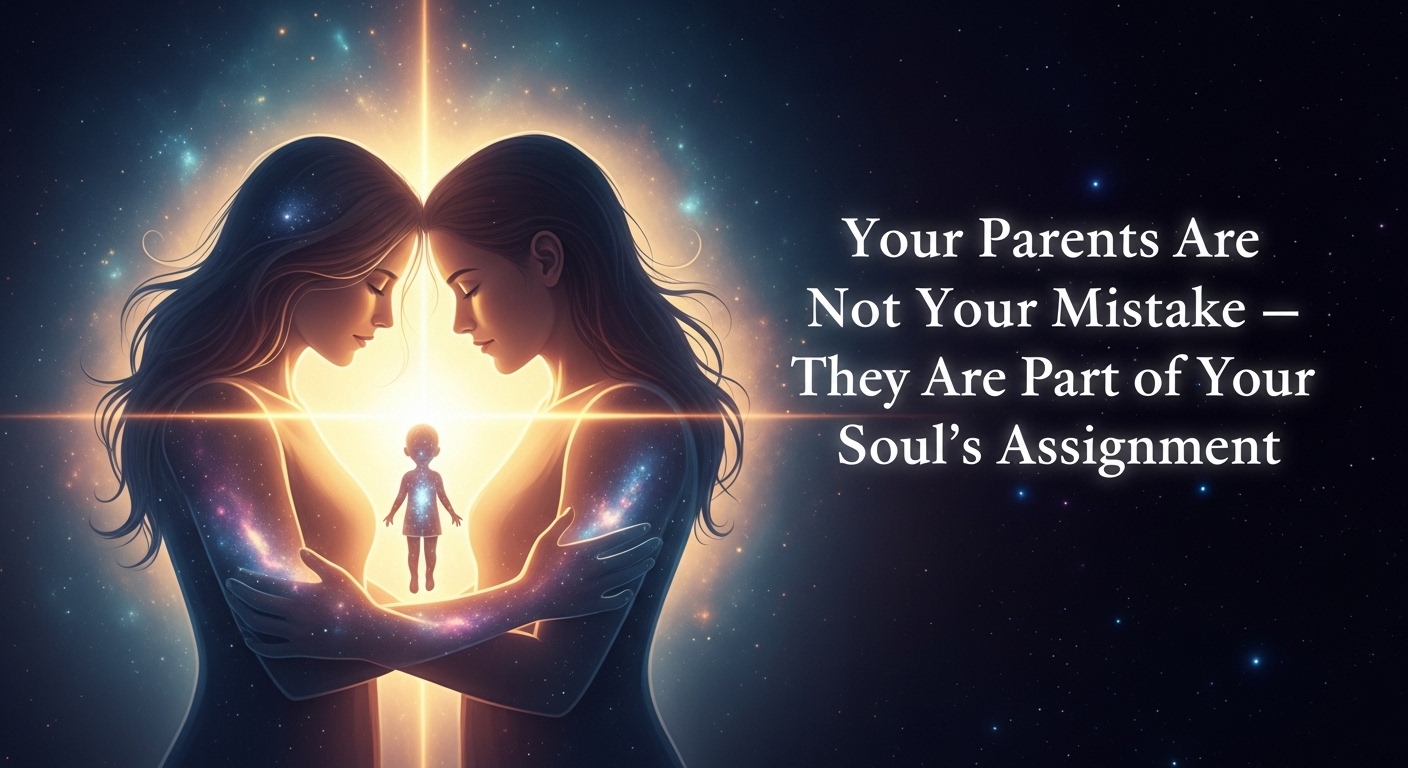
I came across a sentence on Instagram that at first felt like just another poetic line floating through the feed, the kind you usually like and forget within seconds.
“Your parents are not your mistake; they are part of your soul’s assignment.”
But this one didn’t dissolve after scrolling past. It stayed. It followed me quietly, resurfacing at unexpected moments, asking to be looked at more closely. The longer I sat with it, the less it felt like a comforting quote and the more it began to feel like a truth that doesn’t try to soothe — only to explain.
When you look at life through the lens of Vedic astrology, this idea stops being symbolic and becomes disturbingly precise. Nothing about your birth is accidental. Not the timing. Not the place. And certainly not the people you were born to. Your parents are not a coincidence — they are a consequence. Not in a negative sense, but in a karmic one.
You are born into a family through prarabdha karma — the portion of past-life karma that has matured and must be experienced in this lifetime. Your soul doesn’t arrive empty-handed. It arrives carrying unfinished lessons, unresolved emotions, ancestral threads, and patterns that need to be completed, healed, or transcended. Your parents are not randomly assigned to you. They are the exact mirrors required for that work.
This is where discomfort begins, because many people want spiritual explanations only when their stories are gentle. But karma does not always arrive wrapped in comfort. Sometimes it arrives as absence. Sometimes as emotional distance. Sometimes as control, instability, silence, or unspoken pain.
In Vedic astrology, the Moon represents the mind, the emotional body, and the mother. It shows how we were nurtured — or how we weren’t. A calm, supported Moon often reflects emotional safety, warmth, and a sense of being held. But when the Moon is burdened — touched by Saturn’s coldness, Rahu’s confusion, or Ketu’s detachment — it often tells a different story. One where love was inconsistent, emotions were heavy, or the mother herself was struggling in ways she couldn’t articulate.
This is not about blame. Astrology never asks you to judge your parents — it asks you to understand the role they played. Sometimes a mother teaches love not through affection, but through emotional absence that forces the child to learn self-soothing, emotional intelligence, and inner strength. Sometimes the lesson is not “how to receive,” but “how to become.”
The Sun tells a similar story about the father. In Jyotish, the Sun is not only the father — it is the soul itself, the sense of identity, purpose, and authority. A strong Sun often reflects guidance, confidence, and clarity. But when the Sun is weak, eclipsed, or burdened, it frequently shows a complicated relationship with the father — distance, absence, dominance, or ego clashes.
Again, not as punishment — but as initiation.
A father who doesn’t fully show up often pushes the child toward self-definition. Toward finding authority within rather than borrowing it from outside. Toward building identity the hard way. Many people with challenging Sun placements grow into leaders, healers, and independent thinkers precisely because they were not handed validation early in life.
The home itself — shown by the fourth house — carries the emotional imprint of your childhood. When this space is challenged in a chart, it often reflects early instability, lack of safety, or emotional unrest. These souls did not come to be comforted first. They came to learn how to create comfort — from within. They are the ones who build emotional homes for themselves later in life, often for others too.
The ninth house speaks of the father again, but on a higher octave — as dharma, guidance, teachers, and ancestral blessings. When this space is heavy, the soul may grow up without direction, without mentors, without clear belief systems. But in that absence, something else is born: an internal compass. A seeker who does not follow tradition blindly, but arrives at truth through lived experience.
Saturn ties all of this together. Wherever Saturn touches, there is karmic weight. When Saturn is connected to the Sun, Moon, fourth, or ninth house, it often shows a soul that has inherited ancestral responsibilities — emotional debts, unfinished stories, family patterns that need to be ended rather than continued.
These are often the people who feel like they had to grow up too soon. Who learned resilience early. Who became their own parents before they fully understood what that meant. Saturn doesn’t break you — it matures you. It forces emotional adulthood. And yes, it can feel unbearably heavy — until you realize you were never meant to carry it forever. You were meant to transform it.
Rahu and Ketu reveal the deeper karmic axis behind family dynamics. Ketu shows where the soul has already been — where it has completed experiences in past lives. Rahu shows where growth must now happen, even if it feels unfamiliar or uncomfortable. When these shadow planets touch family houses, they often indicate unusual family structures, emotional disconnects, or deep ancestral patterns that feel foreign — as if you don’t fully belong.
But that feeling of not belonging is often the signal that you are here to change something.
Your family was never a backdrop to your life. They were the training ground. The environment designed — sometimes painfully — to awaken specific strengths, awareness, and maturity within you. Maybe your mother taught you emotional depth through her silence. Maybe your father taught independence through his absence. Maybe your ancestors passed down wounds — but also the strength required to heal them.
This is not spiritual bypassing. It does not dismiss pain. It does not romanticize suffering. It simply places responsibility back where it belongs — not in blame, but in awareness.
Vedic astrology does not sugarcoat your story. It clarifies it. Your chart does not ask you to forgive prematurely or understand everything instantly. It asks you to see that your parents were never your mistake.
They were part of the assignment your soul accepted long before you arrived here — not to trap you, but to help you evolve beyond what came before.